Does HR have a strategy?

Many people still think HR is mainly about paperwork like joining letters, leave approvals and salary slips. But HR is much bigger. Human Resource Development is a science rooted in the principles of organisational behaviour. In simple words: HR is understanding how people think, feel, behave, and perform at work.
In any organisation, especially SMEs, every step you take as an employer matters. Every move you make, every word you say (or don’t say) can affect employee motivation, conduct, performance, and results. A casual promise made in an interview, a vague job role, a delayed salary, or unclear rules can slowly damage trust. On the other hand, clarity and consistency can build stability, ownership, and high performance.
How can HR maintain clarity and consistency?
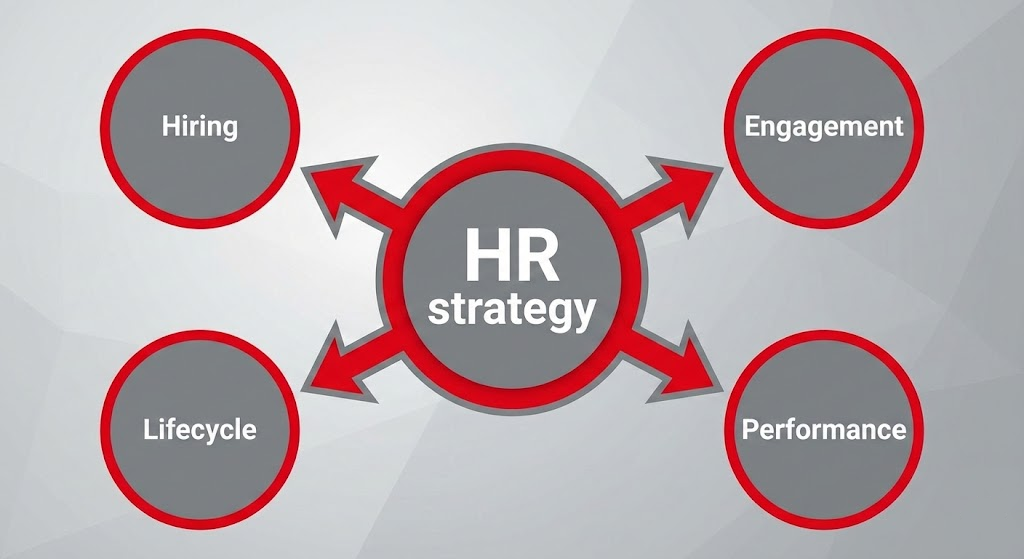
Through well-informed strategy. HR strategy means designing systems that help you build and run strong teams. Our recent video talks about the four aspects must be planned properly:
- How to hire the right people
- How to manage employee lifecycle
- How to measure and reward performance
- How to increase employee engagement and motivation
Let’s break these down and see the correct approach to make the HR strategies aligned with the organisation’s growth.
Hiring Strategy
Hiring is not just filling a vacancy. It is deciding what kind of team an organisation needs to meet its business goals.
Structuring the teams: HR plans what roles you need and how they fit together. Example: If sales is not growing, hiring one more salesperson may not help if there is no sales manager, no lead process, and no support function.
Manpower planning: This is about future needs, not just current gaps. Example: If you plan to open a second branch in six months, your HR will start planning your hiring pipeline now, not at the last minute.
Recruitment strategy: Where will you find the right candidates? Referrals, job portals, campus hiring, consultants? Example: For a customer support role, hiring through a local referral network might work better than portals.
Selection strategy: This is where most organisations make mistakes. Many hire based only on technical knowledge. But performance depends heavily on behaviour and discipline too. A candidate may speak brilliantly in an interview but struggle to implement tasks under pressure. That’s why the HR round and behavioural assessment matter. (Read our blog on this.)
Employee Lifecycle Management Strategy
Once a person joins, an organisation must guide them from Day 1 to exit. A good employee can still fail in a poor system.
Onboarding and exit processes: Through onboarding, HR set expectations. Through exits, the can protect reputation. A good onboarding checklist (role clarity, reporting, tools, first-week goals) can reduce confusion and early attrition.
Time office policies: HR ensures that attendance, leave, work hours, remote work rules, late-coming, and holidays must be clear.
Salary and compliances: Payroll delays and unclear salary structures cause major dissatisfaction. For example: Two employees doing similar work but with different salary breakup and unclear logic can create internal conflict.
Discipline management: A good HR team ensures that discipline is not punishment. It is consistency and fairness. Example: If one team member is repeatedly late without consequence, those caring to come on time might feel cheated.
Performance Management Strategy
If performance is not measured and reviewed properly, employees either overwork blindly or underperform quietly. HR needs a very clear strategy for performance management.
Goal setting (Strategy + KRAs): The HR team guides leaders to set goals that connect to business priorities and individual responsibilities. Example: Instead of “Improve marketing”, set a measurable KRA like “Generate 120 qualified leads per month”.
Reviews: Regular review cycles (annually) create course correction and enable meaningful feedback. One can also conduct quarterly reviews with simple questions like “What went well? What is blocked?” can help employees perform better.
Compensation strategies: Pay increments should be linked to performance and business results. Promising increment during interviews creates wrong expectations. A structured review-based increment system is healthier.
Benefits: Benefits communicate what the organisation values like health, flexibility, growth, family support, etc. Example: A small SME may not afford big bonuses, but can offer clarity, respectful culture, timely salary, and predictable time-offs.
Employee Engagement Strategy
Engagement is not just “fun activities”. It is the overall environment where people feel valued, safe, and motivated to do good work.
Vision, mission, and values setting: People perform better when they understand what the organisation stands for.
Bonding activities: HR should plan activities that support teamwork and relationships, not force participation.
For example: A simple monthly cross-team learning session can also be effective.
Rewards and recognition: Recognition must be fair and consistent.
Training: Training should be continuous, practical, and linked to real work. For example: A sales training programme with role-play + weekly coaching + review will work better than one workshop.
The above points show the impact of every HR action on the organisation’s growth. No doubt, HR needs strategy. Without it, organisations face predictable problems: wrong hires, early attrition, poor performance, confusion, team conflict, and low motivation.
When HR is strategic, an organisation gets better outcomes in hiring, retention, and performance.
If you want HR systems that are simple, practical, and suitable for SMEs, start by reviewing these four areas. Strong teams are not built by chance. They are built by design.
